3. Where can activated carbon be obtained? Where to buy?
You can buy it in several places in Mexico. To purchase pellet, granular and powdered activated carbon for cosmetic use you can contact an expert here: ventas@carbotecnia.com.mx
We also handle activated charcoal for poisoning and indigestion.
How does activated carbon work and what are its benefits?
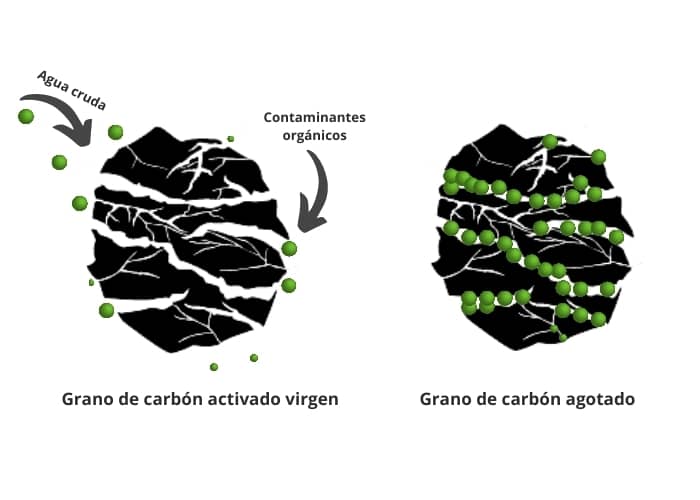
Activated carbon is an adsorption medium, its function is to adsorb organic molecules in its micro pores. It is activated by thermal or chemical processes to enhance its adsorption capacity (to make pores form).
Image explaining how activated carbon works:
On the other hand, activated carbon is an adsorbent, not an absorbent, as shown in the second image:
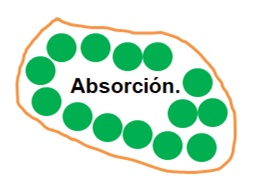
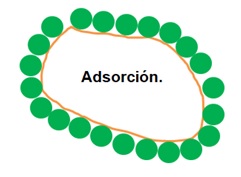
Activated carbon has the ability to adsorb. So, some people put charcoal in the refrigerator to get rid of bad odors. The same happens when you put charcoal in a bucket of water. Eliminates color, taste and odor. Or, in the countryside, people burn and eat tortillas to relieve digestive problems (mild infections, indigestion, bloating, etc.).
Activated carbon involves making it porous to increase its absorbency. One gram of charcoal has a surface area of about 50 square meters. With activation, it reaches 600 to 800 m2, i.e., a 12 to 16-fold increase.
Carbon atom.
The carbon atoms that make up the solid we call “carbon” are held together by covalent bonds. Each atom shares an electron with four other carbon atoms (remember that in an ionic bond, electronegative atoms steal one or more electrons from each other).
Atoms that are not on the surface distribute their four bonds in all directions. But the outer atoms, though bound to four other atoms, are forced to do so in the smaller space, and there are still power imbalances within them. This imbalance is what causes them to trap a liquid molecule surrounding the carbon.
London Force.
The force with which a carbon atom is trapped on the other surface is known as the “London force”, and is one of the seven types of “van der Waals forces”. It is a physical chemical bond, enough to contain the adsorbent material, but not enough to be considered an irreversible chemical bond that forms a new molecular structure. Therefore, adsorption is reversible and the activated carbon can be recycled for reuse.
As we said, the molecules absorbed by carbon tend to be covalent; it changes from ionic, because the latter will try to steal or donate electrons to the carbon atom. The bonds between carbon and hydrogen atoms are covalent, so carbon is a good adsorbent for organic molecules.
Not all organic molecules tend to be covalent. They often contain oxygen, sulfur and other highly electronegative atoms, giving an ionic tendency to the part of the molecule containing them. On the other hand, not all inorganic molecules are ionic; there are also those that tend to be covalent. Such is the case of gold cyanide, which makes activated carbon a fundamental ingredient in the extraction of this precious metal.

 Armenian
  English
  Afrikaans
  Albanian
  Amharic
  Arabic
  Azerbaijani